Find the maximum difference between a node and its descendants in a binary tree
Given a binary tree, find the maximum difference between a node and its descendants in it. Assume that the binary tree contains at-least two nodes.
For example, consider the following tree. The maximum difference between a node and its descendants is 8 – 1 = 7.
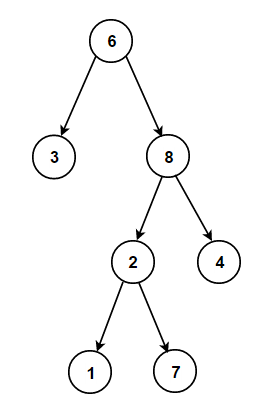
A simple solution would be to traverse the tree, and for every node, find the minimum value node in its left and right subtree. If the difference between the node and its descendants is more than the maximum difference found so far, update it. The time complexity of this solution is O(n2), where n is the total number of nodes in the binary tree.
We can solve this problem linearly by processing the tree nodes in a bottom-up manner by visiting the left and right subtree before processing a node. The function returns the minimum value among all nodes in the subtree rooted at it. So for any node, we can get minimum values in the left and right subtree in constant time. We find the maximum difference for every node, and if the difference is more than the maximum difference found so far, update it.
Following is the C++, Java, and Python implementation of the algorithm:
C++
|
1 2 3 4 5 6 7 8 9 10 11 12 13 14 15 16 17 18 19 20 21 22 23 24 25 26 27 28 29 30 31 32 33 34 35 36 37 38 39 40 41 42 43 44 45 46 47 48 49 50 51 52 53 54 55 56 57 58 59 60 61 62 63 64 65 66 67 68 69 70 71 72 73 74 75 76 77 78 79 80 |
#include <iostream> #include <climits> using namespace std; // Data structure to store a binary tree node struct Node { int data; Node *left, *right; Node(int data) { this->data = data; this->left = this->right = nullptr; } }; // Helper function to find the maximum difference between a node and its // descendants in a binary tree int findMaxDifference(Node* root, int &diff) { // base case: if the tree is empty, return infinity if (root == nullptr) { return INT_MAX; } // recur for the left and right subtree int left = findMaxDifference(root->left, diff); int right = findMaxDifference(root->right, diff); // find the maximum difference between the current node and its descendants int d = INT_MIN; if (min(left, right) != INT_MAX) { d = root->data - min(left, right); } // update the maximum difference found so far if required diff = max(diff, d); // For the difference to be maximum, the function should return // a minimum value among all subtree nodes return min(min(left, right), root->data); } // Find the maximum difference between a node and its descendants in a binary tree int findMaxDifference(Node* root) { int diff = INT_MIN; findMaxDifference(root, diff); return diff; } int main() { /* Construct the following tree 6 / \ / \ 3 8 / \ / \ 2 4 / \ / \ 1 7 */ Node* root = new Node(6); root->left = new Node(3); root->right = new Node(8); root->right->left = new Node(2); root->right->right = new Node(4); root->right->left->left = new Node(1); root->right->left->right = new Node(7); cout << findMaxDifference(root); return 0; } |
Output:
7
Java
|
1 2 3 4 5 6 7 8 9 10 11 12 13 14 15 16 17 18 19 20 21 22 23 24 25 26 27 28 29 30 31 32 33 34 35 36 37 38 39 40 41 42 43 44 45 46 47 48 49 50 51 52 53 54 55 56 57 58 59 60 61 62 63 64 65 66 67 68 69 70 71 72 73 74 75 76 77 78 79 |
import java.util.concurrent.atomic.AtomicInteger; // A class to store a binary tree node class Node { int data; Node left = null, right = null; Node(int data) { this.data = data; } } class Main { // Helper function to find the maximum difference between a node and its // descendants in a binary tree public static int findMaxDifference(Node root, AtomicInteger diff) { // base case: if the tree is empty, return infinity if (root == null) { return Integer.MAX_VALUE; } // recur for the left and right subtree int left = findMaxDifference(root.left, diff); int right = findMaxDifference(root.right, diff); // find the maximum difference between the current node and its descendants int d = Integer.MIN_VALUE; if (Math.min(left, right) != Integer.MAX_VALUE) { d = root.data - Math.min(left, right); } // update the maximum difference found so far if required diff.set(Math.max(diff.get(), d)); // For the difference to be maximum, the function should return // a minimum value among all subtree nodes return Math.min(Math.min(left, right), root.data); } // Find the maximum difference between a node and its descendants in a binary tree public static int findMaxDifference(Node root) { // using `AtomicInteger` to get the result since `Integer` is passed by value // in Java AtomicInteger diff = new AtomicInteger(Integer.MIN_VALUE); findMaxDifference(root, diff); return diff.get(); } public static void main(String[] args) { /* Construct the following tree 6 / \ / \ 3 8 / \ / \ 2 4 / \ / \ 1 7 */ Node root = new Node(6); root.left = new Node(3); root.right = new Node(8); root.right.left = new Node(2); root.right.right = new Node(4); root.right.left.left = new Node(1); root.right.left.right = new Node(7); System.out.print(findMaxDifference(root)); } } |
Output:
7
Python
|
1 2 3 4 5 6 7 8 9 10 11 12 13 14 15 16 17 18 19 20 21 22 23 24 25 26 27 28 29 30 31 32 33 34 35 36 37 38 39 40 41 42 43 44 45 46 47 48 49 50 51 52 53 54 55 56 57 58 59 |
import sys # A class to store a binary tree node class Node: def __init__(self, data, left=None, right=None): self.data = data self.left = left self.right = right # Helper function to find the maximum difference between a node and its # descendants in a binary tree def findMaxDifference(root, diff=-sys.maxsize): # base case: if the tree is empty, return infinity if root is None: return sys.maxsize, diff # recur for the left and right subtree left, diff = findMaxDifference(root.left, diff) right, diff = findMaxDifference(root.right, diff) # find the maximum difference between the current node and its descendants d = root.data - min(left, right) # update the maximum difference found so far if required diff = max(diff, d) # For the difference to be maximum, the function should return # a minimum value among all subtree nodes return min(min(left, right), root.data), diff if __name__ == '__main__': ''' Construct the following tree 6 / \ / \ 3 8 / \ / \ 2 4 / \ / \ 1 7 ''' root = Node(6) root.left = Node(3) root.right = Node(8) root.right.left = Node(2) root.right.right = Node(4) root.right.left.left = Node(1) root.right.left.right = Node(7) print(findMaxDifference(root)[1]) |
Output:
7
The time complexity of the above solution is O(n), where n is the total number of nodes in the binary tree. The auxiliary space required by the program is O(h) for call stack, where h is the height of the tree.
Thanks for reading.
To share your code in the comments, please use our online compiler that supports C, C++, Java, Python, JavaScript, C#, PHP, and many more popular programming languages.
Like us? Refer us to your friends and support our growth. Happy coding :)